

Circle and lag compensation
The task
Section titled “The task”A vertical circle with a radius of 50 mm, 170 mm in front of the base, centred at a height of 310 mm. The flange keeps the orientation it has at the zero pose (pointing forward). The plan has:
- A 3 s minimum-jerk move from the zero pose to the circle.
- Two laps of 4 s each, with the speed eased in and out (1 s ramps).
- A 3 s move back to the zero pose.
scripts/plan_circle.jl solves IK for each sample (residual ≤ 0.001 mm) and checks
the plan: joint limits with a 10° margin, joint speeds ≤ 90°/s, flange height ≥
120 mm. J4 reaches 120° (limit 145°). The first try, at a height of 250 mm, needed
J4 at 137° and the check refused it.
Lag compensation
Section titled “Lag compensation”Each joint gets its target early, by its measured lag
(DEFAULT_LAG = [120, 113, 120, 54, 38, 28] ms).
| Run | Error on the circle (RMS) | Max |
|---|---|---|
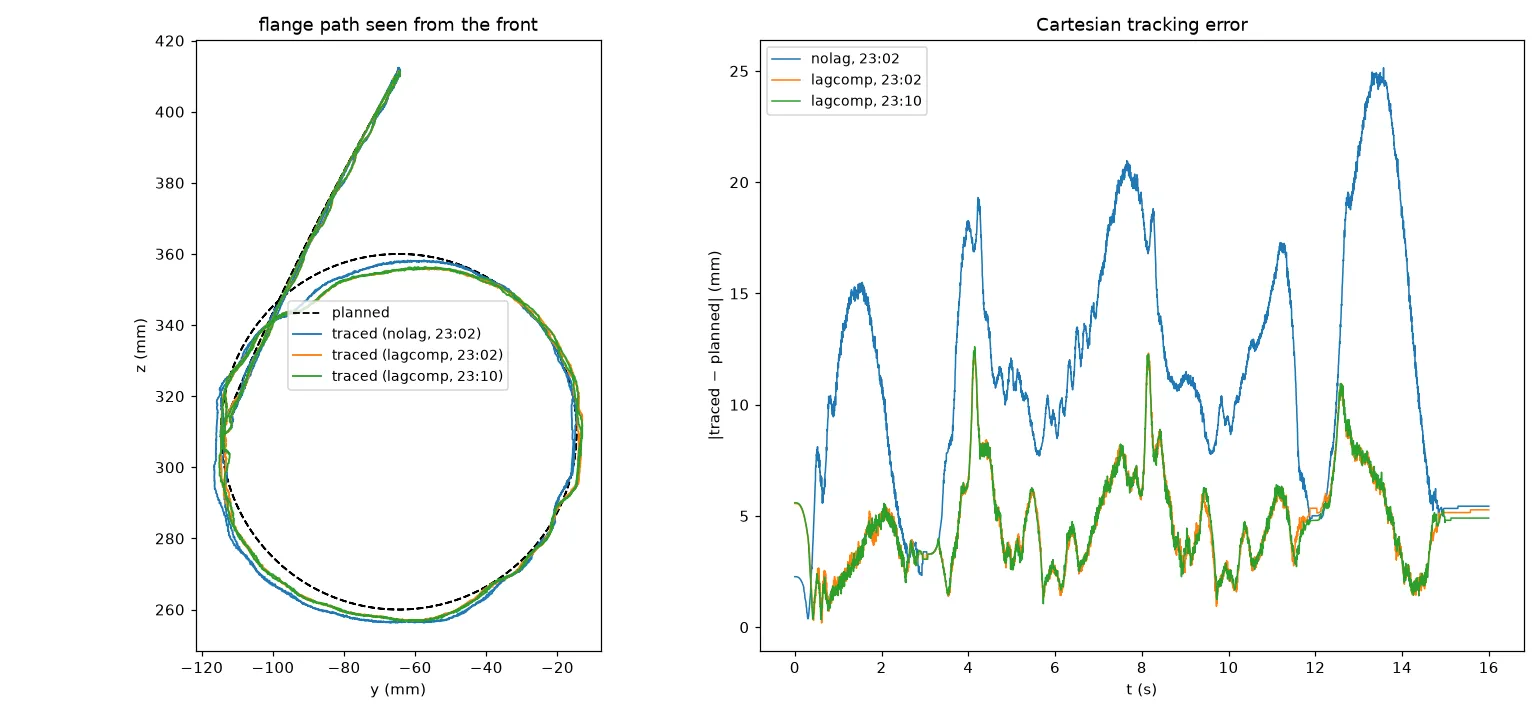
| No lag compensation (Python) | 12.5 mm | 21.0 mm |
| Lag compensation (Python, IK in Python) | 5.2 mm | 12.3 mm |
| Lag compensation (Python player, IK in Julia/RBD) | 5.1 mm | 12.6 mm |
| Lag compensation (Julia player, 284 Hz) | 5.0 mm | 12.4 mm |
| Lag compensation (ATOM, 500 Hz) | 5.0 mm | 12.5 mm |
“Error” is the distance between the planned flange position and the forward kinematics of the measured joint angles. It does not include gear backlash or link flex.
Where the remaining error comes from
Section titled “Where the remaining error comes from”scripts/attribute_error.jl moves one joint at a time to its measured angle:
| J1 | J2 | J3 | J4 | J5 | J6 | |
|---|---|---|---|---|---|---|
| RMS contribution, no lag compensation | 6.7 mm | 9.7 mm | 12.3 mm | 2.3 mm | 0.8 mm | 0 |
| RMS contribution, lag compensation | 1.2 mm | 3.7 mm | 2.0 mm | 0.6 mm | 0.5 mm | 0 |
The peaks (≈4.1, 8.1 and 12.6 s) are J2 and J3 sticking just after they reverse: J2 contributes 7–9 mm and J3 2–5 mm at each peak. J6 does not move the flange point, so its constant 0.7° offset contributes nothing.