

Servo response
These results come from the smooth multi-joint sine runs
(tools/python/smooth_motion_demo.py, 2026-10-03) and the offline analysis
(tools/python/analyze_servo_response.py).
Smooth multi-joint motion
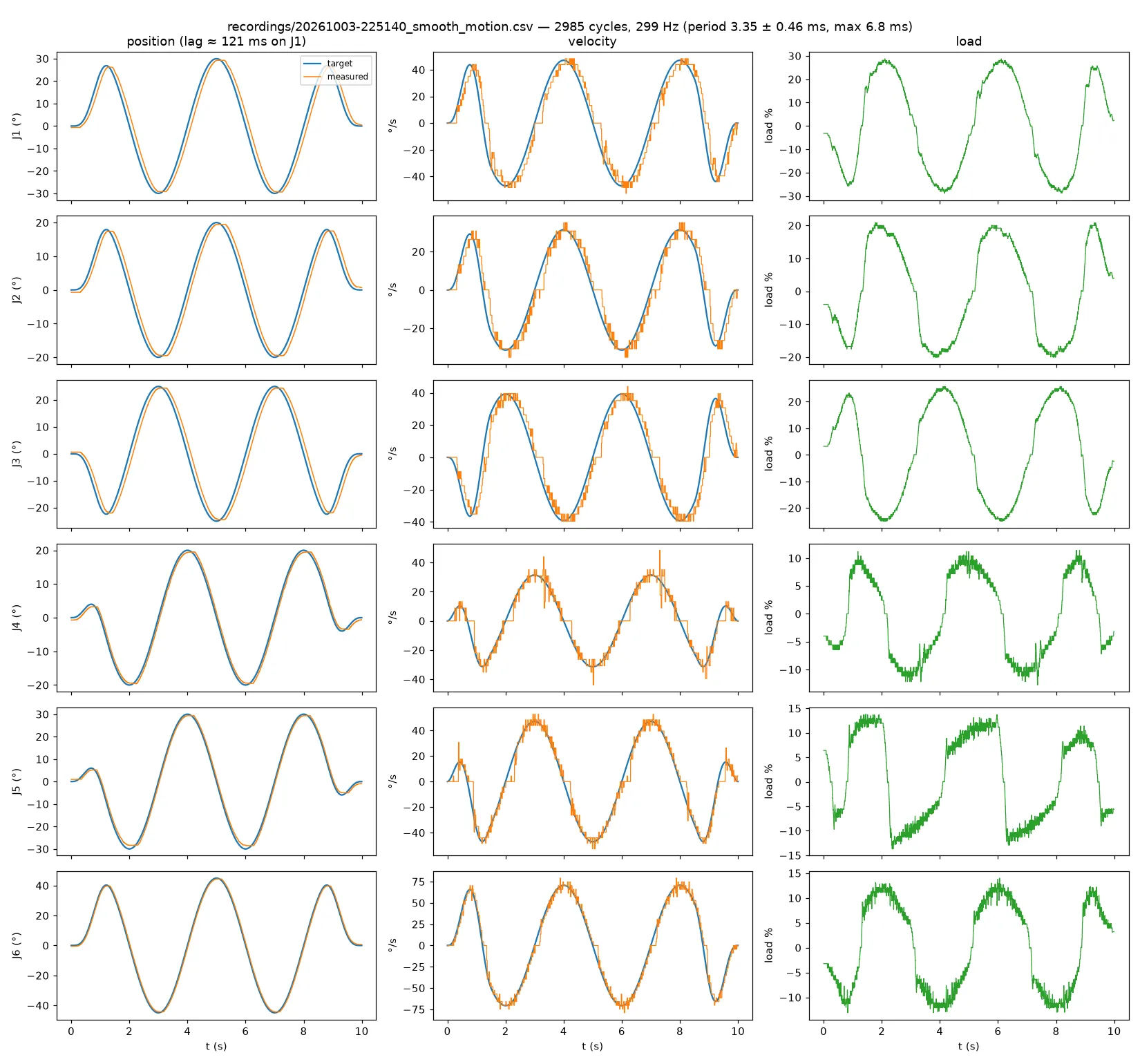
Section titled “Smooth multi-joint motion”All six joints followed sine waves (±20–45°, 4 s period) from the zero pose at ~300 Hz. Two runs gave nearly the same result:
| Joint | RMS error | Lag (best-fit delay) |
|---|---|---|
| J1 | 3.9° | ~120 ms |
| J2 | 2.4° | ~113 ms |
| J3 | 3.2° | ~120 ms |
| J4 | 1.1° | ~54 ms |
| J5 | 1.3° | ~38 ms |
| J6 | 1.4° | ~28 ms |
Response model
Section titled “Response model”A model with a delay and a first-order lag, T q̇ = q_cmd(t − τ) − q, fits better
than a pure delay:
| Joint | τ | T | RMS fit | Validation (second run / circle) |
|---|---|---|---|---|
| J1 | 40 ms | 80 ms | 0.22° | 0.23° / 0.37° |
| J2 | 88 ms | 25 ms | 0.28° | 0.26° / 0.79° |
| J3 | 44 ms | 75 ms | 0.20° | 0.19° / 0.69° |
| J4 | 4 ms | 50 ms | 0.31° | 0.31° / 0.38° |
| J5 | 0 ms | 40 ms | 0.54° | 0.52° / 0.55° |
| J6 | 4 ms | 25 ms | 0.29° | 0.29° / 0.70° |
A pure time shift (what lag compensation does) is correct at one frequency only.
Feedforward through the model, q(t + τ) + T·q̇(t + τ), is on the roadmap.
Sticking after reversals
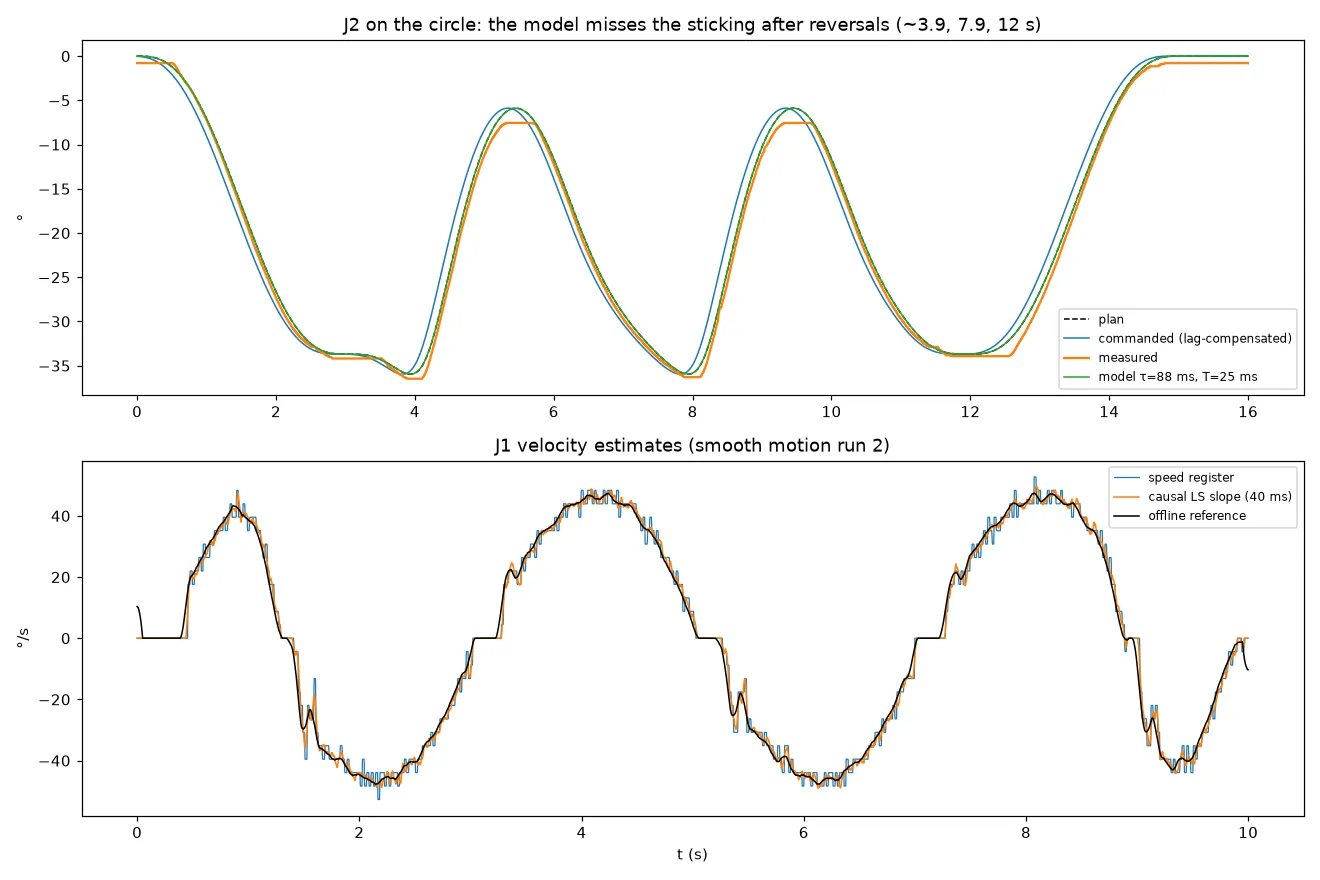
Section titled “Sticking after reversals”After a reversal, J1 and J2 stay still for 0.2–0.5 s while the plan moves. The model does not capture this. It is the main cause of the circle’s error spikes (see Circle).
Friction and the load register
Section titled “Friction and the load register”- The jump of the load at each reversal gives Coulomb friction of 5–8 % on all joints.
- On J1 (no gravity load): load ≈ 2.8 % · sign(v) + 0.53 %/(°/s) · v.
The term proportional to speed is large (27 % at 50°/s). This fits a register that shows PWM duty (back-EMF), not torque.
Velocity estimates
Section titled “Velocity estimates”Against an offline reference (smoothed slope of the position):
| Estimator | RMS error | Lag |
|---|---|---|
| Speed register (50-step quantisation) | 3.1°/s | ~19 ms |
| Finite difference + 10 Hz low-pass | 2.2°/s | ~16 ms |
| Finite difference + 20 Hz low-pass | 2.9°/s | ~9 ms |
| Least-squares slope, last 20 samples | 2.3°/s | ~19 ms |
The 0.088° position resolution limits all of them. A model-based estimator is the next step if a controller needs better velocity.
Velocity mode
Section titled “Velocity mode”J1 in velocity mode tracked 102–103 steps/s for 100 commanded, with ~0.25 s of dead time before it started to move.